


Building the missing operational layer behind AI transformation
How We Work

Most organisations attempt to scale AI before stabilising operational execution.
Operai applies a disciplined transformation sequence that establishes operational clarity before intelligent systems scale.
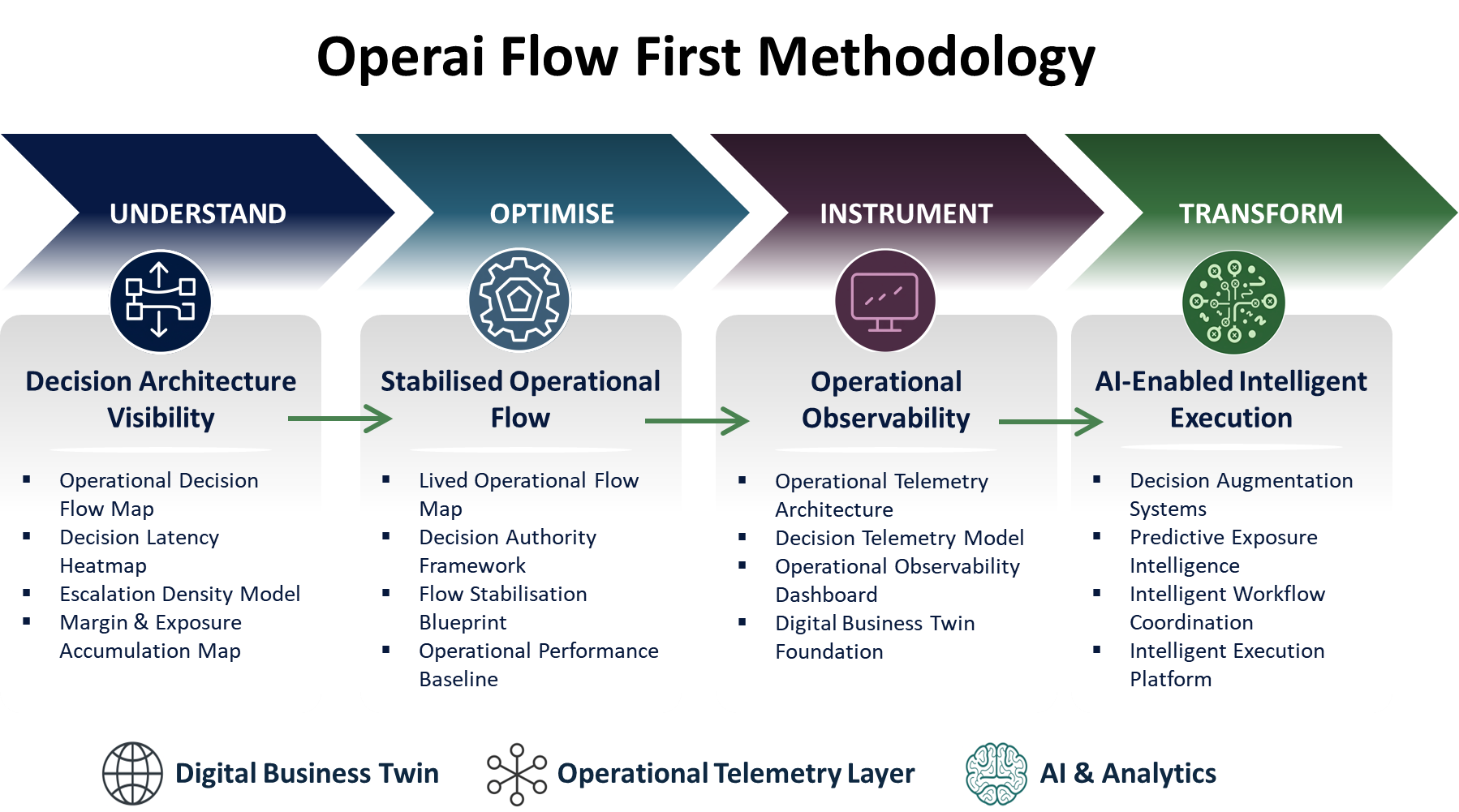
The Understand Phase

Reveal Enterprise Decision Architecture
Most organisations have formal processes describing how work should flow
In reality, operational decisions move through a mixture of formal governance, informal coordination, and escalation behaviour
Operai reconstructs how decisions actually propagate across the enterprise
This reveals the organisation’s Operational Decision Architecture — the structure that ultimately determines execution speed, operational risk, and transformation readiness
The analysis identifies:
• formal and informal decision pathways
• hidden operational workflows
• undocumented decision criteria
• escalation patterns and governance density
• where operational latency accumulates
• where margin and risk exposure build
This stage creates visibility into the operational decision environment before major transformation initiatives accelerate
Operational Decision Architecture Review
6-week executive diagnostic
The Understand phase is delivered through the Operational Decision Architecture Review
This focused engagement works directly with leadership teams to reveal how operational decisions propagate across critical value streams
Leadership gains clarity on:
• how decisions propagate across operational workflows
• where escalation and governance layers accumulate
• where cross-functional latency slows execution
• where margin and risk exposure build
• whether digital and AI initiatives are structurally stable
Board-Ready Clarity Outputs
At the conclusion of the review, leadership receives a structured visibility model including:
• Operational Decision Architecture Map
• Decision Latency Heatmap
• Escalation Density Model
• Margin & Exposure Accumulation Map
• AI Sequencing Risk Assessment
These artefacts reveal the structural constraints affecting operational execution and transformation performance
This clarity establishes the foundation for the next stage of the Operai methodology: operational flow stabilisation
The Optimise Phase

Stabilise Operational Flow
Once decision architecture is visible, Operai focuses on stabilising execution within critical value streams.
This stage simplifies operational flow and removes the structural friction that slows performance.
Intervention focuses on:
Simplifying decision rights
Rationalising governance layers
Reducing escalation density
Stabilising cross-functional coordination
Removing structural bottlenecks
The objective is structural stability before instrumentation and automation.
This stage is delivered through a Value Stream Pilot.
Value Stream Pilot
8–12 week operational intervention
A focused pilot targeting one high-impact operational value stream.
The pilot stabilises execution and demonstrates measurable performance improvement before broader rollout across the organisation.
Typical pilot outcomes include:
Reduced decision latency
Simplified escalation pathways
Improved cross-functional coordination
Reduced operational exposure
Improved execution reliability
Following a successful pilot, the value stream intervention model can be applied iteratively across additional operational domains.
Over time this progressively stabilises the organisation’s execution architecture.
The Instrument Phase

Build Operational Observability
Once operational flow is stabilised, organisations can introduce instrumentation that makes performance dynamics continuously visible.
This stage focuses on establishing operational observability across value streams.
Capabilities may include:
• Defining structural exposure signals
• Integrating cross-system operational telemetry
• Monitoring decision flow and escalation patterns
• Establishing continuous performance visibility
This creates ongoing insight into how the enterprise actually operates.
The Transform Phase

Scale Intelligent Execution
Only once operational architecture is stable and observable should automation and AI be introduced at scale.
At this stage organisations can deploy intelligent execution capabilities such as:
AI-assisted decision environments
Workflow automation
Digital Business Twin models
Scenario simulation and forecasting
Because the underlying operational system is stable and visible, AI improves performance rather than amplifying complexity.
Enterprise Progression

Following the initial intervention, the value stream model can be applied progressively across the organisation.
Each cycle:
Stabilises operational flow
Reduces structural friction
Expands operational visibility
Strengthens enterprise decision architecture
Over time this creates the foundation for scalable intelligent execution and Digital Business Twin capability.
Begin With Clarity

Before accelerating AI investment, leadership should first understand how decisions and work actually flow across the enterprise.
Without this visibility, automation and AI often amplify complexity rather than improve performance.
Operai helps executive teams make operational decision architecture visible so transformation efforts are grounded in operational reality.