Operational Architecture for the AI Era
Most transformation programmes attempt to fix performance before they understand it
We reverse that
Where We Start
How an Operai Engagement Works
One or two value streams - 4-6 weeks - providing a clear picture of what is actually happening
Every engagement starts with the same question: where is the gap between how your operation is designed to run and how it actually behaves day to day?
We identify that together - usually in one or two critical value streams where execution performance matters most and where the cost of the gap is highest. That becomes the starting point.
Before any delivery begins, we agree the measurable outcomes. What will be different. How it will be measured. When we will know it is working.
That agreement is in place before we start — not defined after the fact
We do not begin delivery until we have agreed what success looks like and how it will be measured
Step 1 - Operational Clarity
See how your operation actually behaves - not how it was designed to
Duration: 4–6 weeks
Most organisations have strong systems and good reporting. What those systems show is how the operation was designed to work. What they do not show is how it actually works - the decisions that get escalated, the workflows that diverge under pressure, the informal coordination that fills the gaps, the issues that surface too late.
This is the gap where execution breaks. And it is the gap that AI scales on top of when it is introduced without first being made visible.
In this phase, we map that reality directly. We attend your operational meetings. We trace how decisions actually move - not how they are supposed to. We identify where escalation is building, where workflows are diverging, and where value is leaking from the operation.
What you receive at the end of this phase:
A clear map of how execution actually behaves across the value stream — decisions, workflows, escalation patterns, value leakage
A prioritised intervention sequence — where to act first and why
Defined measurable outcomes for the full engagement — agreed before delivery begins
This phase can stand alone for organisations that need an operational assessment before committing to a full programme
More typically it is the first step of the complete engagement
Step 2 - Transformation Delivery
Fix what is broken. Make performance visible. Then apply AI
Duration: 3–12 months depending on scope
This is where the work happens. Three stages, in sequence, each building on the last.
Redesign and stabilise
Using Lean and Agile sprint methodology, we redesign the workflows and decision pathways identified in Step 1. Decision latency is reduced. Escalation loops are eliminated. Cross-functional coordination is stabilised. Execution becomes consistent in ways it was not before. This is delivered in venture partnership with PBI (Practical Business Improvements) who bring 20 years of Lean and Agile delivery inside Energy, Infrastructure and Resources environments
Make it visible in real time
We deploy targeted telemetry to capture how execution actually behaves — not just what the dashboards report. This creates real-time operational visibility and the data foundation that AI requires to function reliably. It is built on a stable operation. Not on an unstable one.
Apply AI where it improves performance
Once execution is stable and visible, AI is introduced to amplify what is already working. Not to fix what is broken — that work is already done. This is the sequence that makes AI transformation perform. Most organisations attempt it in reverse.
We remain embedded and accountable across all three stages
This phase does not end with a handover- it ends when the outcomes agreed at the start are delivered
Step 3 - Enterprise Scale
Expand what is proven - do not restart
Duration: Ongoing
Once Step 2 delivers proven results in the entry value streams, the model expands across the enterprise. Each additional value stream is built on the operational architecture already in place - the same Flow First sequence, the same accountability model, no re-procurement, no restart.
The telemetry data compounds across value streams. The AI layer becomes more powerful as the instrumented operational footprint grows. The transformation programme deepens rather than concludes.
One enterprise client, fully expanded across multiple value streams over 3 years, represents a sustained high-value transformation relationship - not a series of disconnected engagements.
The AI layer compounds as the instrumented operational footprint grows.
The investment made in the first value stream multiplies across the enterprise rather than sitting in isolation.
What Gets Measured
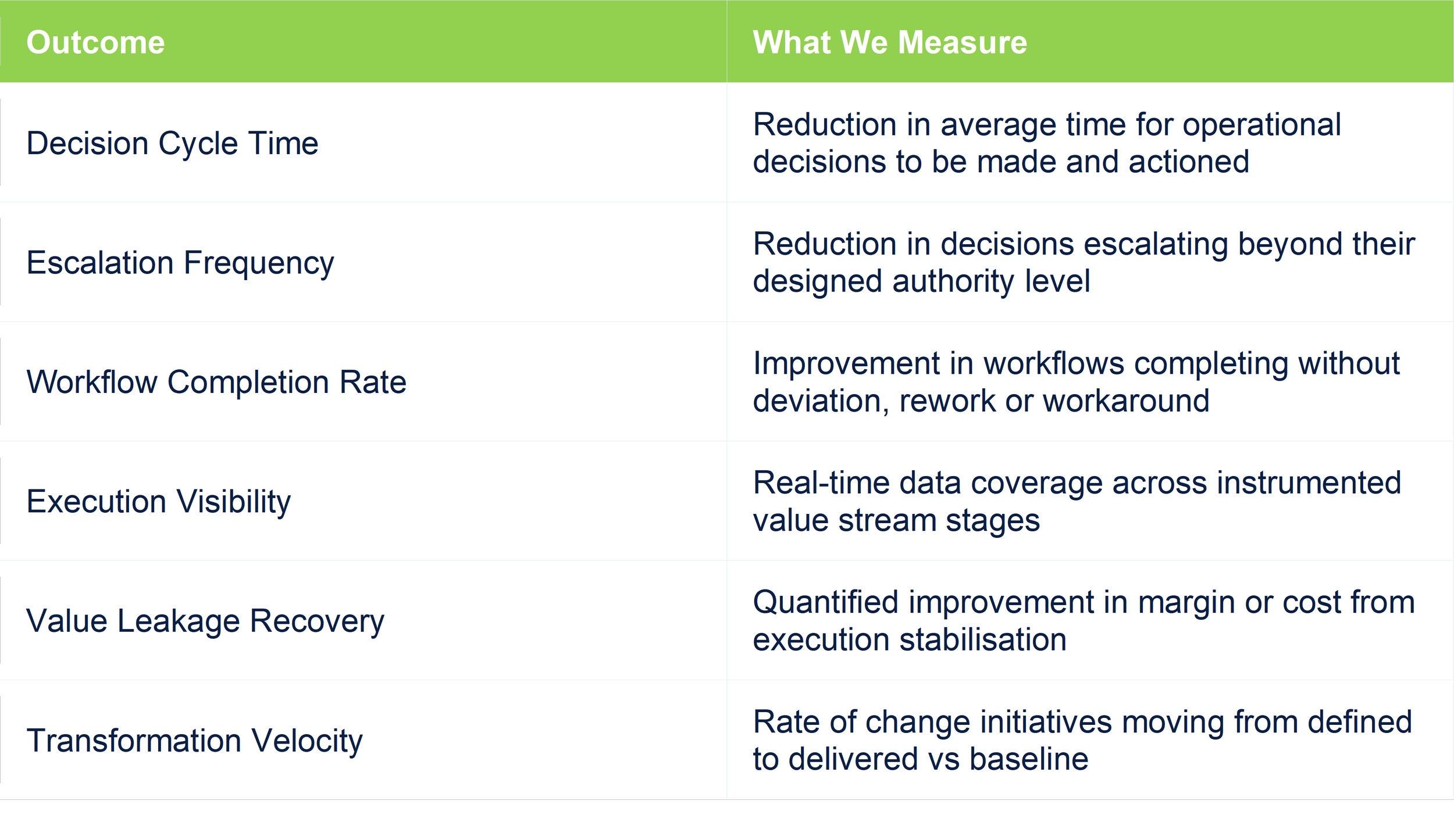
Outcomes are agreed before delivery begins - progress is tracked throughout
These are not generic targets. They are commitments agreed against your operational baseline before Step 2 begins — and tracked through the real-time visibility infrastructure built during delivery.
How Engagements Are Priced
Engagements are scoped and priced per engagement
Step 1: Operational Clarity — fixed fee, 4–6 weeks
Step 2: Transformation Delivery — programme fee anchored to the outcomes defined in Step 1, 3–12 months
Step 3: Enterprise Scale — ongoing partnership, retainer or expanded programme fee
The starting commitment is deliberately contained - one or two value streams, a defined timeframe, measurable outcomes
Once that is proven, the decision to expand is straightforward
The starting point is always one or two critical value streams
Low initial risk, defined scope & measurable outcomes agreed before delivery begins
Worth a 20-minute conversation